
Industry Updates & Marketing Insights: Cold Storage Takes a Hit, Stablecoins Take Over Everything
Published: August 3, 2026 | By: Aaron Barefoot, Founder of ColdChain AEO | Last Updated: August 3, 2026
ColdChain Agency Industry Updates & Marketing Insights Week of July 28 - August 3, 2026
Four stories this week, and they pull in two directions at once. Cold storage, the thing crypto tells people to trust more than an exchange, just had its worst week on record. Meanwhile stablecoins keep getting more legitimate, more regulated, and more embedded in how people actually spend money. Here's what happened, and what it means if you're building or marketing a Web3 brand.
Wallets
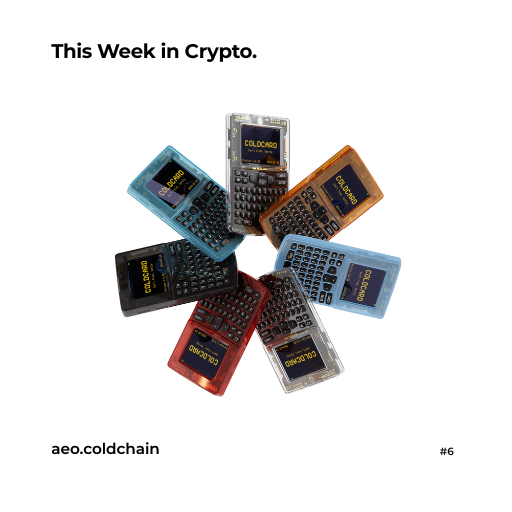
Coldcard hardware wallet hack grows to $89M and counting
Coinkite's Coldcard, long marketed as one of the most trusted names in cold storage, produced wallet seeds with far less randomness than advertised on certain Mk3, Mk4, Mk5, and Q devices. An attacker exploited the weak random number generator to reconstruct private keys offline, without ever touching a physical unit. What started as a $38 million theft from roughly 500 wallets grew across a second and third wave to more than $89 million from nearly 1,200 wallets, and Galaxy Research says none of it has moved yet. Binance founder Changpeng Zhao is now telling holders to split funds across multiple wallets rather than trust any single device completely.
What it means for Web3 marketing: this is the moment custodial exchanges and MPC wallet providers have been waiting for to win back ground lost to "not your keys, not your coins." The accurate, non-opportunistic version of that story is simple: self-custody still beats leaving funds on an exchange, but the device itself is also a trust decision, not a solved problem. Any client with a wallet, custody, or security product should be publishing on this now, while it's still the top result for "hardware wallet hack." The angle that actually ranks and gets cited by AI answer engines is a plain, factual comparison of which custody models (single-sig hardware, multisig, MPC, exchange custodial) would or wouldn't have been exposed to this specific bug. Reactive and useful, not fear-mongering.
Exchanges
One month into MiCA, Binance is still unlicensed and the EU barely noticed
The EU's MiCA grandfathering period closed July 1. Binance, the largest exchange in the world by volume, withdrew its Greek CASP application in June after reports that political forces intervened, and it hasn't requalified anywhere else in the bloc. A month on, the absence hasn't dented the market: exchanges holding a MiCA license now account for roughly 83 to 95% of EU trading volume depending on the source, and the ESMA register has grown past 300 authorized providers, up from around 210 the week the deadline landed.
What it means for Web3 marketing: licensing has become a trust signal that AI answer engines and comparison sites actively surface, and unlicensed exchanges are getting quietly filtered out of "best exchange" and "is X safe" answers regardless of actual size. For clients who are licensed, this is the moment to push CASP status harder in content, schema, and PR, not as a compliance footnote but as the headline differentiator. For anyone still mid-application, the marketing plan needs a contingency for a multi-month gap in EU-facing visibility, because the license is becoming the qualifying signal before price or product ever gets considered.
Cards & Payments
Stablecoin debit cards are becoming the default, not the perk
Card networks stopped treating stablecoins as something to defend against and started building on top of them. Visa's stablecoin settlement pilot is now live across nine blockchains. Mastercard has pushed further into crypto licensing. A new issuer consortium, Open USD, is building a stablecoin designed to share reserve yield with the card programs, wallets, and fintechs that distribute it, a direct shot at Circle's USDC economics (Circle's stock dropped over 17% the day it was announced). Phantom, Swissborg, Revolut, and a growing list of exchange-linked issuers have all shipped or expanded card products in the last few months, most tied to Visa or Mastercard rails rather than closed-loop systems.
What it means for Web3 marketing: card products are quietly becoming the retention layer for exchanges and wallets, because a linked debit card turns a trading account into a spending habit. If a client has a card product, or is weighing one, the content opportunity is comparing real-world usability (fees, cashback structure, Apple Pay and Google Pay support, geographic coverage) rather than restating the announcement, because that's the exact query pattern showing up in AI search right now: "best crypto debit card," "X card vs Y card." The Open USD story is also worth a short explainer on its own. Reserve yield-sharing is a genuinely new mechanic most retail audiences don't understand yet, and being first to explain it well is an easy AEO win.
Stablecoins
Regulators are legitimizing stablecoins and tightening the leash at the same time
Two things are happening at once. The SEC's new guidance lets firms count 98% of qualifying stablecoin value toward regulatory capital, a strong signal that stablecoins are being treated as close to cash-equivalent for institutional purposes. At the same time, Treasury's FinCEN and OFAC have proposed AML and sanctions compliance rules that would require issuers to actively screen and halt flagged transactions, with the FDIC running a parallel proposal. Visa, Meta, Payoneer, and OnePay have all made stablecoin moves in recent months, and Hong Kong's licensing regime is now live alongside GENIUS Act implementation in the US.
What it means for Web3 marketing: "stablecoins are becoming boring, in the best way" is the honest framing, and boring is exactly what institutional and payments-focused prospects want to hear. This is a good week to push content aimed at treasury, fintech, and payments decision-makers rather than retail traders, since that audience is the one actually reading SEC and Treasury guidance and making integration decisions off it. For any client issuing or distributing a stablecoin, publishing a compliance-forward explainer of what the AML and sanctions proposal actually requires, before the generic finance press catches up, is a clean AEO play with a long shelf life.
The Through-Line
Trust just got more expensive to fake in every direction. A hardware wallet with a five-year-old firmware bug lost holders $89 million. An exchange with no EU license lost effectively nothing, because the market had already priced it out. Regulators are handing stablecoins institutional legitimacy while quietly raising the compliance bar to get it. For Web3 brands, the story this week isn't features, it's proof: which custody model, which license, which compliance posture actually holds up when it's tested in public.
ColdChain Agency helps crypto and Web3 brands build AI search visibility and topical authority that holds up under regulatory scrutiny. Get in touch at hello@coldchain.agency.
Sources: CoinDesk, The Block, TheStreet, Forbes, PYMNTS, Spark, CasptTracker, Finance Magnates, Paybis, Bitcoin Foundation